
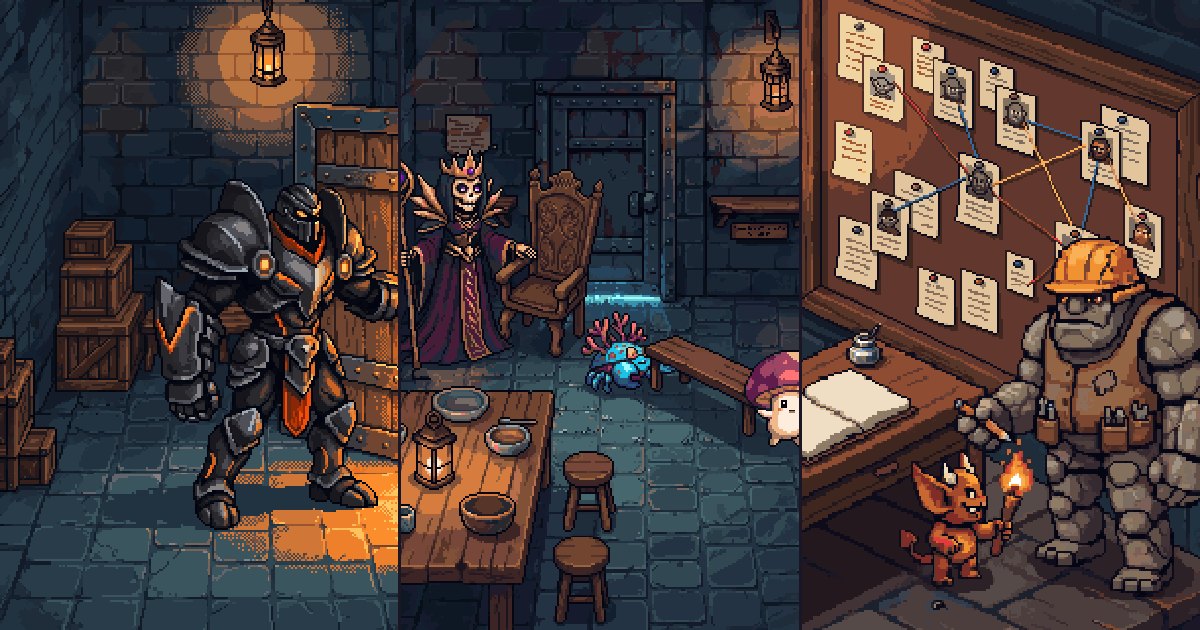
Dungeon Division is a mobile dungeon management game where you side with the dungeon instead of the heroes and hold off invading adventurer parties with your monster staff. Back in Part 4 I made the story the backbone of progression. Your goal is always to clear the next stage, and new features unlock by clearing stages. So wherever the story ends is where the game's main content ends.
As of the night of September 23, the story stopped at Chapter 3. This post covers the six days after that, September 24 to 29: 35 commits by the log. In that stretch I added Chapters 4 and 5 and wrote the game story all the way to a finished ending in Chapters 6 to 10. The cutscenes were drawn with the AI pixel art tool PixelLab. One batch I threw out and redrew the same night, and another had to wait eleven days because I hit a usage limit. The late story would be spoilers, so instead of plot I'll write about how it was written.
Chapters 4 and 5: staff who lost their place
I committed the draft script for Chapters 4 and 5 first, at 10:44 p.m. on the 23rd. It's a 274-line document. If Chapters 1 to 3 were about becoming coworkers while defending Dungeon 7, Chapters 4 and 5 widen that out to other branches.
Chapter 4, "Joint Shift", opens with Dungeon 7 taking on the staff and equipment of Dungeon 4, which has gone under. HQ calls it an efficient merger, but the carts that arrive are loaded with window curtains and half-eaten snacks. For Chapter 5, "Our Business Day", the doc puts the theme like this: "a workplace that doesn't run on any one person's overtime."
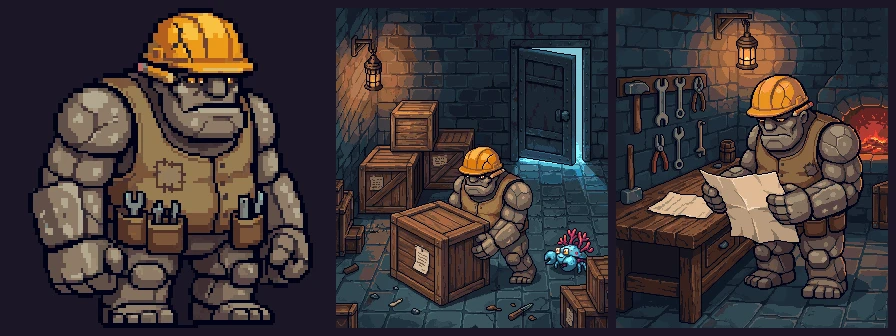
I added only one new character: Dor, a golem who is Facilities Chief of Dungeon 4. Cracked work helmet, stubby pencil, a patched vest. When nervous, Dor corrects the numbers in other people's sentences. The line in the 4-06 epilogue, "I requested repairs three times. ...Four.", comes from that habit.
I also wrote a rule into the doc that existing characters don't get reset. Karon the auditor, who signed against the closure in Chapter 3, doesn't turn back into an enemy. Karon becomes "someone who's friendly but still asks for the grounds for approval and the cost." Gremlin stays an annoying but reliable trading partner. Turning Gremlin into a nice person who fixes things for free would wreck a character built up since Chapter 2. And however much the crisis grows, I don't end every chapter with another closure review.
At 5:34 p.m. on the 26th both chapters went into the game: 12 stages each, so 24 defenses, plus 2 openings and 12 epilogue cutscenes. With five chapter tabs now, I moved the chapter name to just above the map.
Dev notesTuning story difficulty with a simulator
Recommended Power for Chapter 4 runs 5,900 → 8,600, and Chapter 5 runs 8,800 → 11,500. Regular stages step up +200, wall stages (x-06, 08, 10) by +500 to 550, and the stage right after a wall by only +50, so you get a breather after breaking through.
I didn't set enemy levels by hand. I used the story progression simulator's tuning mode to find values where the win rate is 90% or more at the target Power and 40% or less at 80% of it.
Two days later, on the 28th, I raised it another 6%. The simulated player was clearing most of Chapters 4 and 5 at Power above the recommendation without growing at all. I raised all 24 recommendations by 6%, keeping the shape of the curve, and refit enemy levels. Stages that hit the Lv70 cap got a stronger party instead of more levels: Legendary grade for 5-02, an extra potion for 5-09 and 5-11.
Redrawing 19 composite cutscenes with PixelLab that same night
The epilogue cutscene art was the problem. At first I used no image generation at all: 9 existing story illustrations that weren't in use, plus 19 new scenes. Those 19 were composites, battle sprites pasted onto backgrounds. The commit message that day even says "Cutscene art uses no image generator."
Once they were in, they looked wrong. Every character stood in their battle idle pose. In a scene about setting down a box, they just stood next to the box. In a scene about carrying a bench, the bench floated on its own. The lighting didn't match either. So five and a half hours later, at 11:06 p.m., I redrew all 19 with PixelLab and swapped them in.
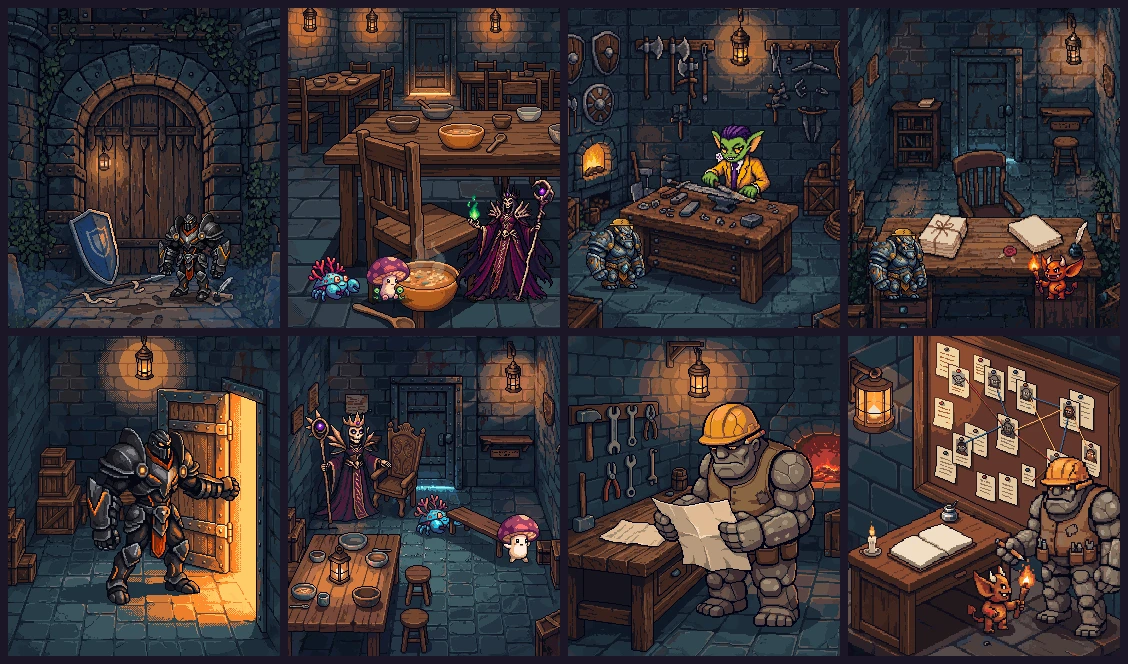
This time the characters actually move inside the scene. They set boxes down, unfold the repair request, carry the bench, put down tea, hand over a hammer and a pencil. I kept the file names, so not one line of game code changed. I did delete the compositing script, though. If anyone ran it again it would overwrite the new art.
A reference drawing for each character first
The same character can't look different from scene to scene. So I locked a full-body reference drawing of Dor first: a gray-brown granite golem, cracked yellow safety helmet, patched brown work vest, tool pouch. I left out moss and crystals on purpose, so Dor wouldn't get mixed up with the Moss Golem staff the player uses.
Dev notesHow I drew cutscenes with PixelLab
I generated 272×320 images with PixelLab's create_image_pro. Two kinds of input went in: an existing story illustration as the style reference, and character references (Dor's reference drawing, staff idle frames, and crops of the Morgana and Gremlin illustrations). Each scene's prompt is saved as a script file in the repo, so I can regenerate under the same conditions later.
Three of the 19 copied the desk layout straight from the reference illustration. I regenerated those with a different style reference. One had letter-like shapes appear on a door sign, and I erased just that part by hand.
That day's verification was the story, loop and unlock checks, plus a progression check that grows a roster continuously from 1-1 to 5-12. The doc also notes that "no real UI capture or Android device check was done."
At 11:58 p.m. the same night I also used PixelLab Pro to redraw the 130 staff species I'd added when the roster went to 180 in Part 5. They were 48 pixels, had no outlines, and were dark and realistic, so next to the older staff they looked like they were from a different game. I fed the existing monsters in as style references, regenerated them, and repacked them into battle sheets, attack frames and portraits.
Giving every staff member a backstory and a name
At 6:54 a.m. on the 27th I added staff records. A "Staff Record" card appears in the info tab of the staff detail screen, and tapping into it shows that staff member's full story and their workplace relationships. Grouping the 185 species with their grade variants gives 120 lines, and there are 81 relationships. Summaries are 60 characters or less in Korean, the body is 3 to 4 paragraphs, and each relationship gets one title plus a sentence from each side.
It's pure flavor with no effect on battles, economy or saves. I still wrote down world rules for it. Falling in battle isn't death. Morgana can't bring anyone back. The secretary is never tied to a specific species. The Chairman and the king never appear.
Two days later, on the morning of September 29, I renamed the staff. Originally the species name was the name: "Ember Slime", "Coral Crab". I changed that to an epithet plus a given name and moved the species name small below it. The Ember Slime became "Veteran Dumba" and the Coral Crab became "Old-Timer Selmo". The night before, I'd put the name candidates on an illustrated review page and picked from there. Each one has a line of reasoning. Selmo's was "came to work even on the day the closure notice arrived, and still keeps one end of the bench free for the new hires."
On the night of the 24th I also built the presentation for when a staff member or boss joins as a story reward: a beam of light, a flash, the portrait popping out, a name tag and a "New in Codex" stamp. It opens 0.9 seconds after the result screen appears, and the result screen tutorial waits until it closes.
Screens I fixed between chapters
I didn't only write story. On the evening of the 24th I reworked the forge. When you picked several items to dismantle, every tap redrew the whole page, so the screen flickered and the scroll jumped back to the top. Now only the tapped card updates. I added quick select by grade too. It skips locked, equipped and upgraded gear and Legendaries automatically, and if anything Epic or above or anything upgraded is in the selection, the confirm dialog warns you once more. The upgrade tab became an icon grid and shows the +3, 6, 9, 12 and 15 substat steps on a track.
On the morning of the 27th I played through from start to finish and fixed 18 screens from what I noted down. Dark outlines on the text over wooden buttons, NEW labels instead of red dots, all 3 floors fitting on the lineup screen, and one shared lock card for locked features (raids, Business, facilities). A bug turned up too. After loading a save, opening a regular defense result showed an empty raid report. When the save was restored, the raid info slot came back as an empty object instead of "nothing", and the game took that for a raid result.
Writing the game story to the end, Chapters 6 to 10
At 10:21 p.m. on the 26th, five hours after Chapters 4 and 5 went in, I committed the planning doc for Chapters 6 to 10. 626 lines. Six minutes later I revised it once more and left a commit titled "Plan story chapters 6 to 10 as the ending". Then at 3:13 p.m. on the 29th I implemented all five chapters.
I won't write the plot. But here are some rules I set for writing the ending.
- Start as few new threads as possible. End it by paying off setups already planted in Chapters 1 to 5. The doc has a table of 10 open threads with a column for the chapter that closes each one.
- Don't switch to an epic tone because it's the finale. HQ stays in memo voice to the end, the secretary keeps making snarky remarks, and the adventurers stay solemn.
- No villains. The other side is people who judge by numbers and reports, and you win by showing them records and actions.
- Don't scale it up to world peace. Guild adventurers need to keep coming, so the daily defense content after the ending doesn't clash with the story.
- Don't undo what Chapter 5 taught. The last crisis isn't solved by someone pulling an all-nighter either.
I also designed the first line of Chapter 1 and the last line of Chapter 10 as a pair, but that one's better seen in the game.
Dev notesChecking the difficulty curve to the ending with the simulator first
Before writing Chapters 6 to 10, I ran simulator probes, on a temporary copy so the original stayed untouched. I wanted to see whether the recommended Power curve would hold even if no staff joined as story rewards after Chapter 5. It held, with conditions: more Soulstone rewards, the story enemy level cap opened to 200, Dungeon Lv30 from Chapter 8, and the simulated player awakening with duplicates and doing gold hires.
In the actual implementation I made the curve steeper than Chapters 1 to 5. From Chapter 6 at 12,800 → 16,000 up to Chapter 10 at 27,400 → 30,800, each chapter adds +3,200 to 3,500. The 60 stages of Chapters 6 to 10 give 150 Soulstones per element on first clear. Only story parties can go up to Lv250; the Lv70 cap on regular visiting parties stays.
Results on the 29th: at the final battle's recommended Power of 30,800, a 100% win rate over 30 seeds, and 0% at 80% of it. A model that grows continuously from 1-1 to 10-12 reached the last stage at 30,811 Power and cleared it. The story came to 10 chapters and 118 stages.
The map keeps the existing 540-pixel canvas and splits the chapter buttons into two pages of five. Clearing 10-12 puts a "complete" mark on the map, and the lobby's main button changes to "Complete · Today's Visitors", leading into Repel (regular defense).
The art came eleven days later
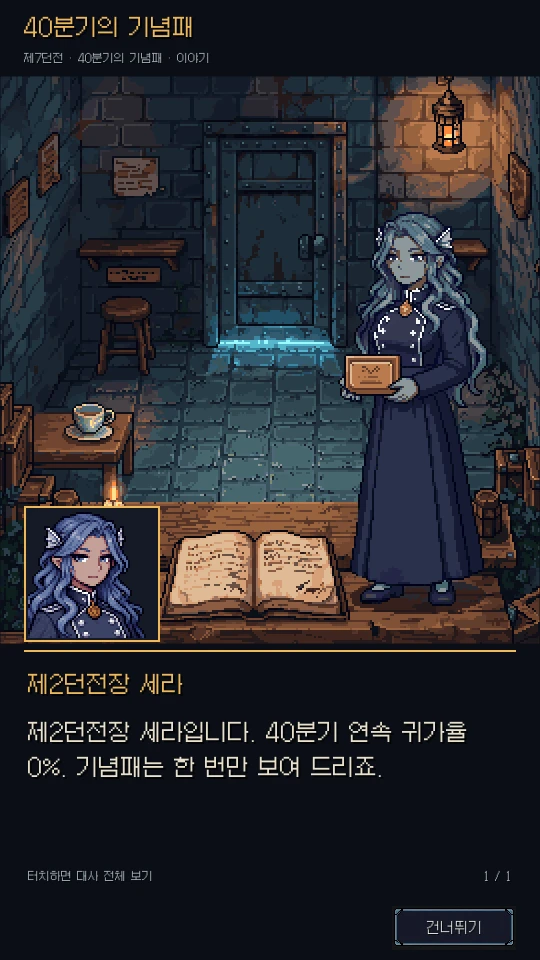
The implementation doc from the 29th says: "Due to PixelLab usage limits, no new art was produced; existing resources were linked to every scene." Dialogue, cutscene transitions and replay were all wired up, and Chapter 1 to 5 art sat in the image slots as placeholders. Alongside that I made a list of which art was plugged into each scene and how many new shots it needed.
I finished that list at 1:42 p.m. on October 10: 35 scenes, 125 shots and 2 full-body illustrations of new characters. Per chapter that's 23 shots for Chapter 6, 23 for 7, 22 for 8, 21 for 9 and 36 for 10. Chapter 10 has more because the final cutscene alone has 11 shots.
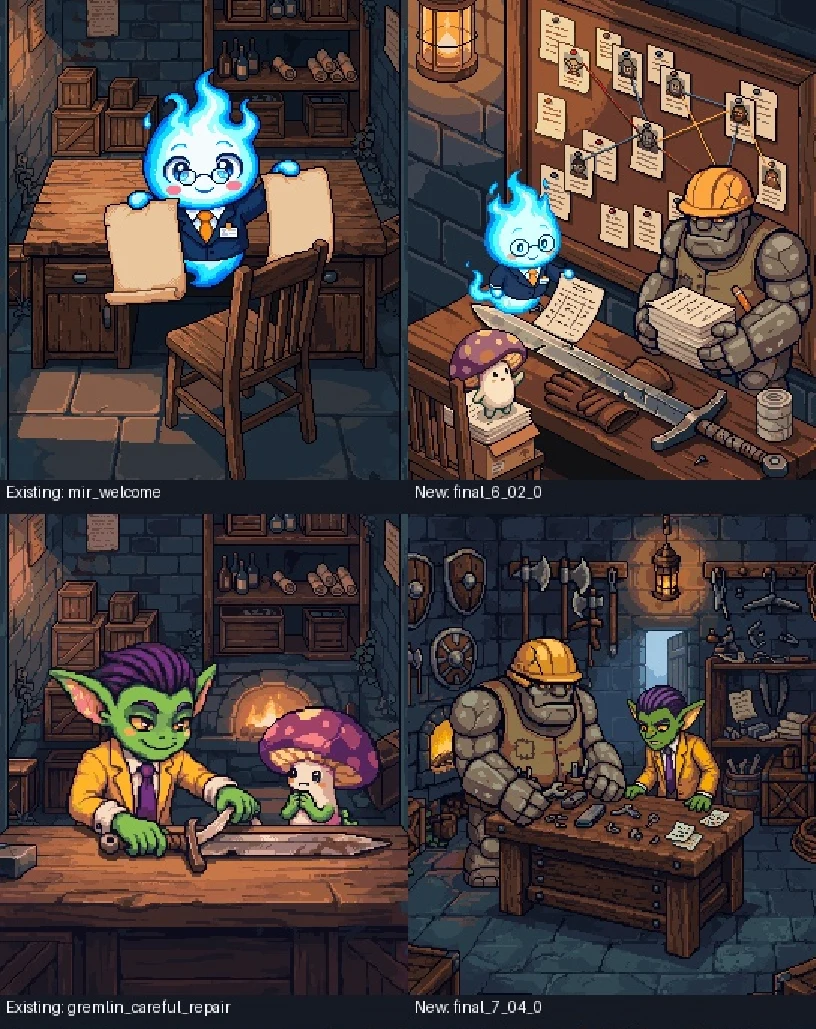
Once the new art was in, the old art started to bother me. At 4 p.m. that day I put the 106 existing illustrations side by side with the new standard and partially touched up only 5. Karon's face looked too young in one of them, the mushroom staff's hat changed color from scene to scene, and Mir's glasses were missing in one. I checked that every pixel outside the edited areas matched the original. Then I used the game's real cutscene player to step automatically through the openings and 73 cutscenes, 529 lines of dialogue and 265 image transitions, start to finish.
Key commits, Sep 23-29, 2026 (plus Oct 10 art)
- Draft script for Chapters 4 and 5
- Forge dismantle and upgrade screens reworked
- Join presentation for story-reward staff and bosses
- 24 stages of Chapters 4 and 5, 19 composite cutscenes
- Planning doc for Chapters 6 to 10
- Redrew the 19 Chapter 4-5 cutscenes with PixelLab
- Redrew 130 staff species in the house style
- Staff records and workplace relationships
- 18 screens tidied after a playthrough review
- Chapter 4-5 difficulty raised 6%
- Staff names as epithet + given name
- Chapters 6 to 10 and the ending implemented
- 125 cutscene shots for Chapters 6 to 10
- Consistent character looks, cutscene playback check
Looking back on those six days
The story reached its ending eleven days before its art did. The order was backwards, but because I'd plugged in placeholder art and tuned the dialogue and difficulty all the way through first, on October 10 all I had to do was swap images. Throwing out the composite cutscenes the same night worked the same way. With file names and hookup points decided up front, I could change the art as many times as I liked and the code never budged.
The plot I held back in this post is all in the game. You can see what kind of game it is on the game page (Korean) first. The next post is about what you do after beating the story: Guildmaster showdowns and hard mode.
NOW AVAILABLE
Dungeon Division
Heroes are intruders, monsters are staff. Save Dungeon No. 7 from being shut down.
Available on the Korean App Store (iPhone/iPad), with English in Settings. Android is not out yet.